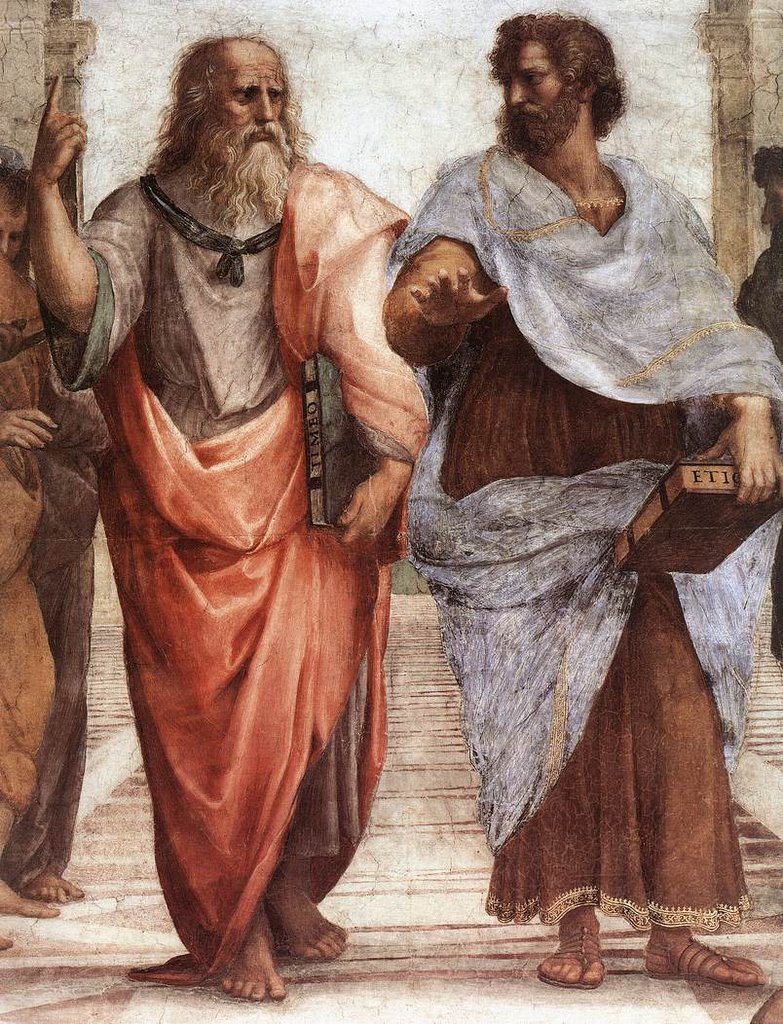
Plato (c. 428-c. 347 BC), Greek philosopher, one of the most original and influential thinkers in the history of philosophy from Plato occidental.La figure is essential for understanding the history of Western thought . The goal of philosophy as well as the very essence of the philosopher in the Platonic system, are Emile Bréhier issues addressed in the following text.
The constitutes the unity of all these forms, which, somehow, the need is the desire to determine the position of the philosopher in the city and its moral and social mission. In the Greece of that time, the philosopher ever defined by comparison with other types of speculation, scientific or religious, but rather by their relationship and their differences with the speaker, the sophist and the political. Philosophy is the discovery of a new form of intellectual life, moreover, is inseparable from social life. The dialogues we describe that life and with it, dramas and comedies that have emerged from it. In some respects, this philosophy clashed with the customs firmly implanted in Greece at the time, it was inevitable conflicts they occur, resulting tragic was the death of Socrates.
What is the philosopher? Plato offers many descriptions. In the Phaedo (64 and ff.) Is the man that has been purified from the defects of the body, which lives only for the soul and not fear death, since in this life, his soul is separated from body. In the Theaetetus (172 c-177 c) is the man clumsy and skilled in their relationships with men who never find their place in human society and lack of influence in the city. In the Republic, is the head of the city and it is he who, in the Laws (X, 909 a), becomes the kind of Inquisitor, wishing "the salvation of the soul" of citizens, requires the inhabitants of the city's belief in the gods of the same under the threat of life imprisonment. It is, finally, the enthusiastic and inspired the Phaedrus (224 a ff.) And the Symposium (210 a). In these descriptions successive two key traits that seem contradictory: on the one hand, the philosopher must "flee from here," purified, live in contact with realities that the sophist or ignore political, on the other hand, must build the just city, whose social relations reflect the exact relationships and stringent are the subject of science. The philosopher, on the one hand, wise removed from the world and, secondly, the wise and just policy that gives the true laws of the city. Plato himself was not it, at once, founder of the Academy, a friend of mathematicians and astronomers and, moreover, an advisor to Dion and Dionysius, the tyrant? Also, if as a philosopher was the inventor or promoter of a rigorous logic, which was also inspired by the spirit remain sterile without the impulse of Eros, and could not breed but the beautiful, reasoned discussion unfolds in a dialectic of love translates into lyrical effusions and mystical contemplation. Sage and mystic, philosopher and politician, are traits typically separated and never get together, through this story, but in some great reformers of the nineteenth century. Therefore it is important to understand well what is your link unión.2. Originally called Aristocles life, Plato (nickname given by the meaning of this term in Greek, "the broad-shouldered") was born into an aristocratic family in Athens. His father, Ariston, was believed to have descended from the early kings of Athens, while his mother, Perictione descended from Dropides, belonging to the family of the sixth century BC lawmaker Solon. His father died when he was still a child and his mother remarried with Pyrilampes, associate of the statesman Pericles. As a young man Plato had political ambitions but he became disillusioned with the rulers of Athens. Later he was a disciple of Socrates, accepting his basic philosophy and dialectical style of debate: the pursuit of truth through questions, answers and more questions. Although this is a very controversial episode, which some scholars consider a literary metaphor about power, Plato witnessed the death of Socrates in the Athenian democratic regime in the year 399 BC, perhaps fearing for his life, some time and left Athens went to Megara and Syracuse.
In 387 BC Plato founded in Athens Academy, an institution often considered the first European university. It provided a comprehensive curriculum, including such subjects as Astronomy, Biology, Mathematics, Political Theory and Philosophy. Aristotle was the most outstanding student.
In order to combine the philosophy and the ability to implement policy reforms went to Sicily in 367 BC, to become tutor of the new tyrant of Syracuse, Dionysius the Younger. The experiment failed. Plato still made a third trip to Syracuse in 361 BC, but again his engagement in Sicilian affairs met with little success. He spent the last years of his life lecturing and writing in the Academy. He died in Athens at an age close to 80 years, possibly in 348 or 347 BC
3.Obra Plato's writings took the form of dialogues, through which were displayed, discussed and criticized philosophical ideas in the context of a conversation or debate involving two or more partners. The first group of Plato's work includes 35 dialogues and 13 letters. Has questioned the authenticity of conversations and most of the cards.
3.1. Early Platonic dialogues dialogues can be divided into four stages of composition. The first is Plato's attempt to communicate the philosophy and dialectical style of Socrates. Some of these dialogues take the same argument. Socrates meets someone who claims to know much, he professes to be ignorant and seeks assistance he claims to know. However, as Socrates begins to raise questions, it is clear that sage who is said not really know what he claims to know, and Socrates emerges as the wiser one because, at least, he knows he knows nothing. That knowledge, of course, is the beginning of wisdom. Within this group of dialogues are Euthyphro (a consideration of the nature of piety and religion) Laques (una búsqueda del significado del valor), Cármides (un intento por definir la templanza), la Apología de Sócrates (donde narra la defensa que de sí mismo ejerció Sócrates en el juicio que le condujo a la muerte) y Protágoras (una defensa de la tesis de que la virtud es conocimiento y que es posible aprenderla).
3.2. Diálogos de transición, madurez y vejez Los diálogos de los periodos intermedio y último de la vida de Platón reflejan su propia evolución filosófica. Las ideas de esas obras se atribuyen al propio Platón, aunque Sócrates sigue siendo el personaje principal en muchas de ellas. Los escritos del periodo de transición abarcan, entre otros diálogos, Gorgias (a consideration of several ethical questions), Meno (a discussion of the nature of knowledge), Lysis (a discussion of friendship) and the first book of the Republic (a discussion of justice). Their dialogues
maturity include the Symposium (Plato's outstanding dramatic achievement, which contains several speeches on beauty and love), Cratylus (about language), Phaedo (death scene of Socrates, in which he discusses the theory of ideas, the nature of the soul and the question of immortality), Phaedrus (about beauty and love) and books II to X of the Republic (which are a detailed discussion of the nature of justice).
Among the works of old-age period include the Theaetetus (a denial that knowledge must be identified with sense perception), Parmenides (a critical evaluation of the theory of ideas), The Sophist (further discussion on ideas or Forms), Philebus (discussion of the relationship between pleasure and the good), Timaeus (Plato's ideas about natural science and cosmology) and The Laws (a more practical political and social issues). 4.Teoría
ideas center Plato's philosophy is his theory of forms or ideas. At bottom, the idea of \u200b\u200bknowledge, his ethical theory, his psychology, his concept of the state and his conception of art must be understood from that perspective.
4.1. Theory of Knowledge Theory of the ideas of Plato and his theory of knowledge are so interrelated that must be addressed jointly. Influenced by Socrates, Plato was convinced that knowledge can be attained. He was also convinced of two essential characteristics of knowledge. First, the knowledge must be certain and infallible. Second, knowledge must have as its object what is really real, in contrast to what is only in appearance. As for Plato what is real has to be fixed, permanent and unchanging, he identified the real with the ideal sphere of existence in opposition to the physical world of becoming. One consequence of this approach was his rejection of empiricism, the claim that all knowledge comes from experience. He thought that propositions derived from the experience they have, at most, a degree of probability. Are not true. Moreover, the objects of experience are changeable phenomena of the physical world, therefore the objects of experience are not proper objects of knowledge.
The Plato's theory of knowledge was exposed mainly in the Republic, particularly in his discussion on the image of the divided line and the myth of the cave. In the former, Plato distinguishes between two levels of awareness: opinion and knowledge. Statements or statements about the physical or visible world, including the views and propositions of science are just opinion. Some of these opinions are well founded and not others, but none of them should be seen as true knowledge. The highest point is knowledge, since it involves reason rather than experience. The reason, use of properly, leading to ideas that are true and objects of these rational insights are true universals, the eternal Forms or substances that constitute the real world.
The myth of the cave describes individuals chained in the deepest part of a cave. Tied facing the wall, his vision is limited and therefore can not tell anyone. All you see is the wall of the cave upon which reflect models or statues of animals and objects passing in front of a glowing bonfire. One man runs away and leaves in the light of day. With the help of the Sun, this person first sees the real world and returns to the cave, saying that the only things they have seen so far are shadows and appearances and the real world awaits them abroad if they want to discharge their ties. The world of shadows of the cave symbolizes for Plato the physical world appearances. The trip to the sunny world is outside the cave symbolizes the transition into the real world, the world of full and perfect existence, which is the object of knowledge.
4.2. Nature of ideas Theory of ideas can be better understood in terms of mathematical entities. A circle, for example, is defined as a plane figure composed of a series of points all equidistant from one place. However, nobody has actually seen the figure.
What people have seen are drawn figures that are more or less accurate approximations of the ideal circle. In fact, when mathematicians define a circle, the points referred to are not spatial, but logical. No space. However, although the shape of a circle is not ever seen-and you can not see ever-mathematicians and others do know what it is. For Plato, therefore, form a circle there, but not in the physical world of space and time. There is an immutable object in the field of ideas, which can only be known by reason. The ideas are more entity objects in the physical world both because of their perfection and stability and the fact of being role models, similarities to objects that have common physical reality. Circular shapes, square and triangular are excellent examples of what Plato meant by idea. An object that exists in the physical world can be called a circle, square, triangle, because it seems ("participate" in the words of Plato) to the idea of \u200b\u200ba circle, square or triangle.
Plato extended his theory beyond the field of mathematics. Actually, I was more interested in its application in the field of social ethics. The theory was his way of explaining how the same universal term can refer to many things or particular events. The word justice, for example, can apply to hundreds of specific actions because these acts have something in common, they seem to, participate in, the idea of \u200b\u200bjustice. A person is human because it resembles or participates in, the idea of \u200b\u200bhumanity. If humanity is defined in terms of being a rational animal, then a person is human because it is rational. A particular act may be considered brave or coward because part of that idea. An object is beautiful because it partakes of the idea, or form, of beauty. Therefore, everything in the world of space and time is what it is by virtue of its resemblance to its universal idea. The ability to define the universal term is evidence that it has mastered the idea to which that universal refers.
Plato conceived the ideas in a hierarchical fashion: the supreme idea of \u200b\u200bGod is like the sun in the myth of cave, illuminates all the other ideas. The idea of \u200b\u200bGod represents the passage of Plato in the direction of an ultimate principle of explanation. At bottom, the theory of ideas is intended to explain the way in which one reaches the knowledge and also how things have become what they are. In philosophical language, the theory of Plato's ideas is both an epistemological theory (theory of knowledge) as an ontological thesis (theory of being).
political 5.Teoría Republic, most political work of Plato, is the question of justice and therefore the questions what is a fair state? and who is an individual right?
The ideal state, according to Plato, consists of three classes. The economic structure of the state lies in the merchant class. Security, military and political leadership is assumed by the philosopher-kings. The class a person is determined by an educational process that begins at birth and continues until that person has reached the highest level of education compatible with their interests and abilities. Those who complete the entire educational process become philosopher-kings. Are those whose minds have developed as they are able to understand the ideas and, therefore, make the wisest decisions. In fact, the educational system Plato's ideal is primarily structured to produce philosopher-kings.
associated the traditional Greek virtues with the class structure of the ideal state. Temperance is the only virtue of the artisan class, the value is under the military class and wisdom characterizes the rulers. Justice, the fourth virtue, characterizes society as a whole. The just state is one in which each class must perform its own function without going into the activities of other classes. Plato
applied to the analysis of the human soul a similar pattern: the rational, the will and appetites. A righteous person is one whose rational element, supported by the will, controls appetite. There is a clear analogy with the previous state structure, in which the philosopher-kings, aided by the soldiers, govern the rest of society.
6.Ética Plato's ethical theory rests on the assumption that virtue is knowledge and it can be learned. This doctrine must be understood in the whole of his theory of ideas. As already mentioned, the latest idea for Plato is the idea of \u200b\u200bGod and knowledge of this idea is the guide on the verge of taking a moral decision. He maintained that to know God is doing good. The consequence of this is that anyone who behaves immorally does so from ignorance. This conclusion derives from his certainty that a virtuous person is really happy and as individuals always desire their own happiness, always eager to do what is moral.
7.Arte antagonistic Plato had an idea of \u200b\u200bart and the artist even endorsing some forms of religious art and moralist. His focus has to see once more with his theory of ideas. A beautiful flower, for example, is a copy or imitation of the universal ideas of flowers and beauty. The physical flower is a reproduction of reality, ie, of ideas. A picture of the flower is, therefore, a high reproduction of reality. This also means that the artist is a reproduction of a second order of knowledge and, indeed, Plato's frequent criticism toward the artists was that they lacked actual knowledge of what they were doing. Artistic creation, he noted, seemed to be rooted in an inspired madness.
8.Influencia Plato's influence throughout the history of philosophy has been immense. His Academy existed until 529, when it was closed by Emperor Justinian I, who opposed the dissemination of its pagan teachings. The impact of Plato in Jewish thought is apparent in the work of first-century Alexandrian philosopher Philo of Alexandria. Neoplatonism, founded in the third century by the philosopher Plotinus was an important further development of the ideas of Plato. The theologians Clement of Alexandria, Origen and St. Augustine were early Christian exponents of a Platonic perspective. Platonic ideas had a crucial role in the development of Christianity and in medieval Islamic thought.
During the Renaissance, the first center of Platonic influence was the Florentine Academy, founded in the XV century near Florence. Under the leadership of Marsilio Ficino, members studied Plato in ancient Greek. In England, Platonism was revived in the seventeenth century by Ralph Cudworth and others who became known as the Cambridge School. The influence Plato has reached the twentieth century by the hand of thinkers as Alfred North Whitehead, who once paid him tribute by describing philosophy as a simple "set of annotations of Plato."
The constitutes the unity of all these forms, which, somehow, the need is the desire to determine the position of the philosopher in the city and its moral and social mission. In the Greece of that time, the philosopher ever defined by comparison with other types of speculation, scientific or religious, but rather by their relationship and their differences with the speaker, the sophist and the political. Philosophy is the discovery of a new form of intellectual life, moreover, is inseparable from social life. The dialogues we describe that life and with it, dramas and comedies that have emerged from it. In some respects, this philosophy clashed with the customs firmly implanted in Greece at the time, it was inevitable conflicts they occur, resulting tragic was the death of Socrates.
What is the philosopher? Plato offers many descriptions. In the Phaedo (64 and ff.) Is the man that has been purified from the defects of the body, which lives only for the soul and not fear death, since in this life, his soul is separated from body. In the Theaetetus (172 c-177 c) is the man clumsy and skilled in their relationships with men who never find their place in human society and lack of influence in the city. In the Republic, is the head of the city and it is he who, in the Laws (X, 909 a), becomes the kind of Inquisitor, wishing "the salvation of the soul" of citizens, requires the inhabitants of the city's belief in the gods of the same under the threat of life imprisonment. It is, finally, the enthusiastic and inspired the Phaedrus (224 a ff.) And the Symposium (210 a). In these descriptions successive two key traits that seem contradictory: on the one hand, the philosopher must "flee from here," purified, live in contact with realities that the sophist or ignore political, on the other hand, must build the just city, whose social relations reflect the exact relationships and stringent are the subject of science. The philosopher, on the one hand, wise removed from the world and, secondly, the wise and just policy that gives the true laws of the city. Plato himself was not it, at once, founder of the Academy, a friend of mathematicians and astronomers and, moreover, an advisor to Dion and Dionysius, the tyrant? Also, if as a philosopher was the inventor or promoter of a rigorous logic, which was also inspired by the spirit remain sterile without the impulse of Eros, and could not breed but the beautiful, reasoned discussion unfolds in a dialectic of love translates into lyrical effusions and mystical contemplation. Sage and mystic, philosopher and politician, are traits typically separated and never get together, through this story, but in some great reformers of the nineteenth century. Therefore it is important to understand well what is your link unión.2. Originally called Aristocles life, Plato (nickname given by the meaning of this term in Greek, "the broad-shouldered") was born into an aristocratic family in Athens. His father, Ariston, was believed to have descended from the early kings of Athens, while his mother, Perictione descended from Dropides, belonging to the family of the sixth century BC lawmaker Solon. His father died when he was still a child and his mother remarried with Pyrilampes, associate of the statesman Pericles. As a young man Plato had political ambitions but he became disillusioned with the rulers of Athens. Later he was a disciple of Socrates, accepting his basic philosophy and dialectical style of debate: the pursuit of truth through questions, answers and more questions. Although this is a very controversial episode, which some scholars consider a literary metaphor about power, Plato witnessed the death of Socrates in the Athenian democratic regime in the year 399 BC, perhaps fearing for his life, some time and left Athens went to Megara and Syracuse.
In 387 BC Plato founded in Athens Academy, an institution often considered the first European university. It provided a comprehensive curriculum, including such subjects as Astronomy, Biology, Mathematics, Political Theory and Philosophy. Aristotle was the most outstanding student.
In order to combine the philosophy and the ability to implement policy reforms went to Sicily in 367 BC, to become tutor of the new tyrant of Syracuse, Dionysius the Younger. The experiment failed. Plato still made a third trip to Syracuse in 361 BC, but again his engagement in Sicilian affairs met with little success. He spent the last years of his life lecturing and writing in the Academy. He died in Athens at an age close to 80 years, possibly in 348 or 347 BC
3.Obra Plato's writings took the form of dialogues, through which were displayed, discussed and criticized philosophical ideas in the context of a conversation or debate involving two or more partners. The first group of Plato's work includes 35 dialogues and 13 letters. Has questioned the authenticity of conversations and most of the cards.
3.1. Early Platonic dialogues dialogues can be divided into four stages of composition. The first is Plato's attempt to communicate the philosophy and dialectical style of Socrates. Some of these dialogues take the same argument. Socrates meets someone who claims to know much, he professes to be ignorant and seeks assistance he claims to know. However, as Socrates begins to raise questions, it is clear that sage who is said not really know what he claims to know, and Socrates emerges as the wiser one because, at least, he knows he knows nothing. That knowledge, of course, is the beginning of wisdom. Within this group of dialogues are Euthyphro (a consideration of the nature of piety and religion) Laques (una búsqueda del significado del valor), Cármides (un intento por definir la templanza), la Apología de Sócrates (donde narra la defensa que de sí mismo ejerció Sócrates en el juicio que le condujo a la muerte) y Protágoras (una defensa de la tesis de que la virtud es conocimiento y que es posible aprenderla).
3.2. Diálogos de transición, madurez y vejez Los diálogos de los periodos intermedio y último de la vida de Platón reflejan su propia evolución filosófica. Las ideas de esas obras se atribuyen al propio Platón, aunque Sócrates sigue siendo el personaje principal en muchas de ellas. Los escritos del periodo de transición abarcan, entre otros diálogos, Gorgias (a consideration of several ethical questions), Meno (a discussion of the nature of knowledge), Lysis (a discussion of friendship) and the first book of the Republic (a discussion of justice). Their dialogues
maturity include the Symposium (Plato's outstanding dramatic achievement, which contains several speeches on beauty and love), Cratylus (about language), Phaedo (death scene of Socrates, in which he discusses the theory of ideas, the nature of the soul and the question of immortality), Phaedrus (about beauty and love) and books II to X of the Republic (which are a detailed discussion of the nature of justice).
Among the works of old-age period include the Theaetetus (a denial that knowledge must be identified with sense perception), Parmenides (a critical evaluation of the theory of ideas), The Sophist (further discussion on ideas or Forms), Philebus (discussion of the relationship between pleasure and the good), Timaeus (Plato's ideas about natural science and cosmology) and The Laws (a more practical political and social issues). 4.Teoría
ideas center Plato's philosophy is his theory of forms or ideas. At bottom, the idea of \u200b\u200bknowledge, his ethical theory, his psychology, his concept of the state and his conception of art must be understood from that perspective.
4.1. Theory of Knowledge Theory of the ideas of Plato and his theory of knowledge are so interrelated that must be addressed jointly. Influenced by Socrates, Plato was convinced that knowledge can be attained. He was also convinced of two essential characteristics of knowledge. First, the knowledge must be certain and infallible. Second, knowledge must have as its object what is really real, in contrast to what is only in appearance. As for Plato what is real has to be fixed, permanent and unchanging, he identified the real with the ideal sphere of existence in opposition to the physical world of becoming. One consequence of this approach was his rejection of empiricism, the claim that all knowledge comes from experience. He thought that propositions derived from the experience they have, at most, a degree of probability. Are not true. Moreover, the objects of experience are changeable phenomena of the physical world, therefore the objects of experience are not proper objects of knowledge.
The Plato's theory of knowledge was exposed mainly in the Republic, particularly in his discussion on the image of the divided line and the myth of the cave. In the former, Plato distinguishes between two levels of awareness: opinion and knowledge. Statements or statements about the physical or visible world, including the views and propositions of science are just opinion. Some of these opinions are well founded and not others, but none of them should be seen as true knowledge. The highest point is knowledge, since it involves reason rather than experience. The reason, use of properly, leading to ideas that are true and objects of these rational insights are true universals, the eternal Forms or substances that constitute the real world.
The myth of the cave describes individuals chained in the deepest part of a cave. Tied facing the wall, his vision is limited and therefore can not tell anyone. All you see is the wall of the cave upon which reflect models or statues of animals and objects passing in front of a glowing bonfire. One man runs away and leaves in the light of day. With the help of the Sun, this person first sees the real world and returns to the cave, saying that the only things they have seen so far are shadows and appearances and the real world awaits them abroad if they want to discharge their ties. The world of shadows of the cave symbolizes for Plato the physical world appearances. The trip to the sunny world is outside the cave symbolizes the transition into the real world, the world of full and perfect existence, which is the object of knowledge.
4.2. Nature of ideas Theory of ideas can be better understood in terms of mathematical entities. A circle, for example, is defined as a plane figure composed of a series of points all equidistant from one place. However, nobody has actually seen the figure.
What people have seen are drawn figures that are more or less accurate approximations of the ideal circle. In fact, when mathematicians define a circle, the points referred to are not spatial, but logical. No space. However, although the shape of a circle is not ever seen-and you can not see ever-mathematicians and others do know what it is. For Plato, therefore, form a circle there, but not in the physical world of space and time. There is an immutable object in the field of ideas, which can only be known by reason. The ideas are more entity objects in the physical world both because of their perfection and stability and the fact of being role models, similarities to objects that have common physical reality. Circular shapes, square and triangular are excellent examples of what Plato meant by idea. An object that exists in the physical world can be called a circle, square, triangle, because it seems ("participate" in the words of Plato) to the idea of \u200b\u200ba circle, square or triangle.
Plato extended his theory beyond the field of mathematics. Actually, I was more interested in its application in the field of social ethics. The theory was his way of explaining how the same universal term can refer to many things or particular events. The word justice, for example, can apply to hundreds of specific actions because these acts have something in common, they seem to, participate in, the idea of \u200b\u200bjustice. A person is human because it resembles or participates in, the idea of \u200b\u200bhumanity. If humanity is defined in terms of being a rational animal, then a person is human because it is rational. A particular act may be considered brave or coward because part of that idea. An object is beautiful because it partakes of the idea, or form, of beauty. Therefore, everything in the world of space and time is what it is by virtue of its resemblance to its universal idea. The ability to define the universal term is evidence that it has mastered the idea to which that universal refers.
Plato conceived the ideas in a hierarchical fashion: the supreme idea of \u200b\u200bGod is like the sun in the myth of cave, illuminates all the other ideas. The idea of \u200b\u200bGod represents the passage of Plato in the direction of an ultimate principle of explanation. At bottom, the theory of ideas is intended to explain the way in which one reaches the knowledge and also how things have become what they are. In philosophical language, the theory of Plato's ideas is both an epistemological theory (theory of knowledge) as an ontological thesis (theory of being).
political 5.Teoría Republic, most political work of Plato, is the question of justice and therefore the questions what is a fair state? and who is an individual right?
The ideal state, according to Plato, consists of three classes. The economic structure of the state lies in the merchant class. Security, military and political leadership is assumed by the philosopher-kings. The class a person is determined by an educational process that begins at birth and continues until that person has reached the highest level of education compatible with their interests and abilities. Those who complete the entire educational process become philosopher-kings. Are those whose minds have developed as they are able to understand the ideas and, therefore, make the wisest decisions. In fact, the educational system Plato's ideal is primarily structured to produce philosopher-kings.
associated the traditional Greek virtues with the class structure of the ideal state. Temperance is the only virtue of the artisan class, the value is under the military class and wisdom characterizes the rulers. Justice, the fourth virtue, characterizes society as a whole. The just state is one in which each class must perform its own function without going into the activities of other classes. Plato
applied to the analysis of the human soul a similar pattern: the rational, the will and appetites. A righteous person is one whose rational element, supported by the will, controls appetite. There is a clear analogy with the previous state structure, in which the philosopher-kings, aided by the soldiers, govern the rest of society.
6.Ética Plato's ethical theory rests on the assumption that virtue is knowledge and it can be learned. This doctrine must be understood in the whole of his theory of ideas. As already mentioned, the latest idea for Plato is the idea of \u200b\u200bGod and knowledge of this idea is the guide on the verge of taking a moral decision. He maintained that to know God is doing good. The consequence of this is that anyone who behaves immorally does so from ignorance. This conclusion derives from his certainty that a virtuous person is really happy and as individuals always desire their own happiness, always eager to do what is moral.
7.Arte antagonistic Plato had an idea of \u200b\u200bart and the artist even endorsing some forms of religious art and moralist. His focus has to see once more with his theory of ideas. A beautiful flower, for example, is a copy or imitation of the universal ideas of flowers and beauty. The physical flower is a reproduction of reality, ie, of ideas. A picture of the flower is, therefore, a high reproduction of reality. This also means that the artist is a reproduction of a second order of knowledge and, indeed, Plato's frequent criticism toward the artists was that they lacked actual knowledge of what they were doing. Artistic creation, he noted, seemed to be rooted in an inspired madness.
8.Influencia Plato's influence throughout the history of philosophy has been immense. His Academy existed until 529, when it was closed by Emperor Justinian I, who opposed the dissemination of its pagan teachings. The impact of Plato in Jewish thought is apparent in the work of first-century Alexandrian philosopher Philo of Alexandria. Neoplatonism, founded in the third century by the philosopher Plotinus was an important further development of the ideas of Plato. The theologians Clement of Alexandria, Origen and St. Augustine were early Christian exponents of a Platonic perspective. Platonic ideas had a crucial role in the development of Christianity and in medieval Islamic thought.
During the Renaissance, the first center of Platonic influence was the Florentine Academy, founded in the XV century near Florence. Under the leadership of Marsilio Ficino, members studied Plato in ancient Greek. In England, Platonism was revived in the seventeenth century by Ralph Cudworth and others who became known as the Cambridge School. The influence Plato has reached the twentieth century by the hand of thinkers as Alfred North Whitehead, who once paid him tribute by describing philosophy as a simple "set of annotations of Plato."


0 comments:
Post a Comment